Patios
Sandstone Paving in Ascot
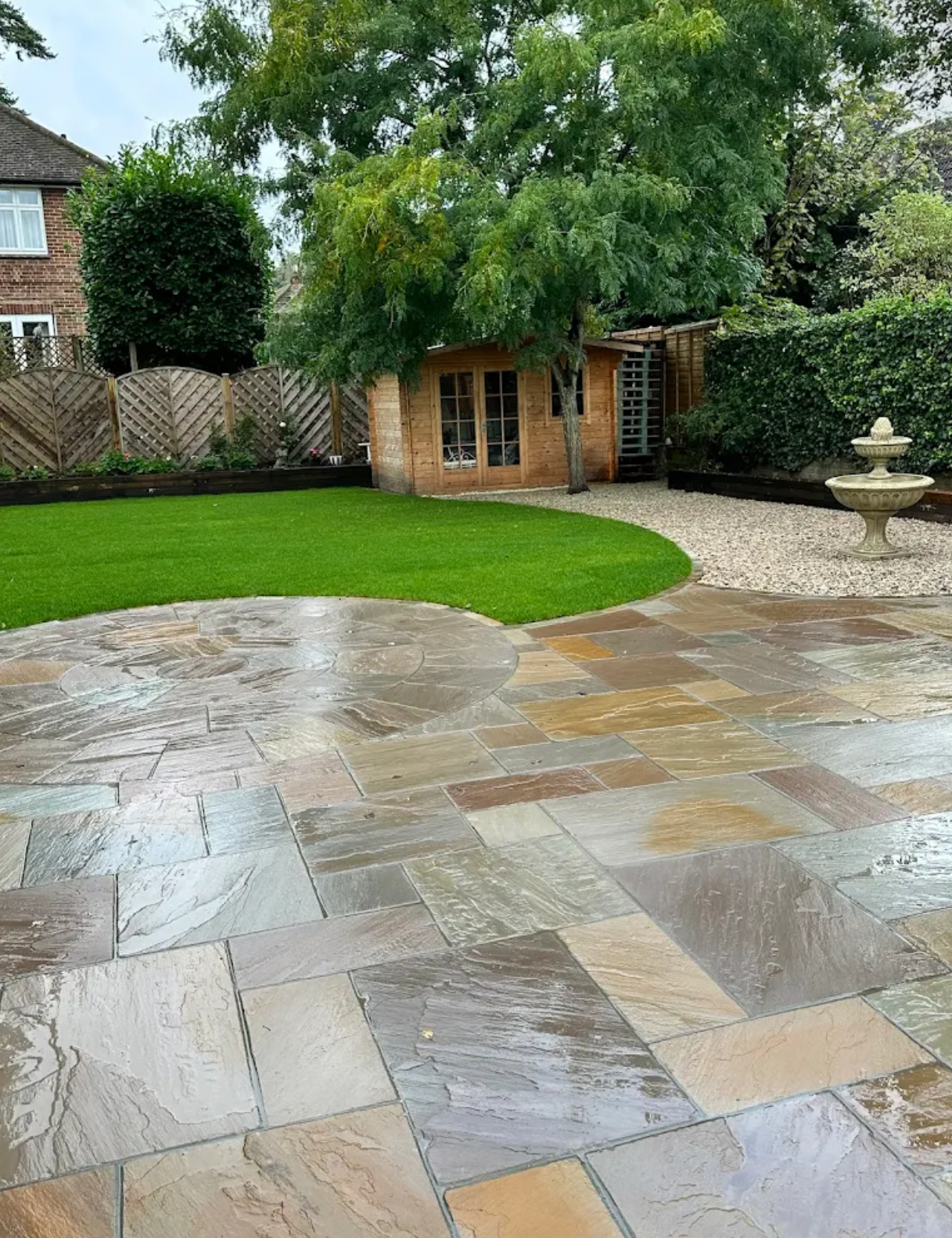
Warm, riven natural stone with genuine colour variation — a material that still looks at home against the brick and render found around Ascot.
Indian sandstone remains one of the most popular natural stone patio materials we lay in Ascot because it is affordable, characterful and forgiving to walk on. It is a natural product though, which means shade variation, thickness variation and a genuine need for correct bedding and pointing.
Why natural sandstone
No manufactured product replicates the depth of a riven sandstone surface — the subtle banding, the shifts of grey into buff into rust across a single patio. Against period brickwork near Sunninghill or a rendered elevation closer to Bracknell, it settles in immediately in a way that a perfectly uniform slab never does.
It is also naturally slip-resistant thanks to its riven face, comfortable underfoot, and available in mixed-size packs that let us lay a random-coursed pattern with real character.
- Genuine natural material with unique colour variation
- Riven surface gives good natural grip
- Excellent value compared with most natural stones
- Available in mixed-size packs for random or coursed layouts
Colours and how they weather
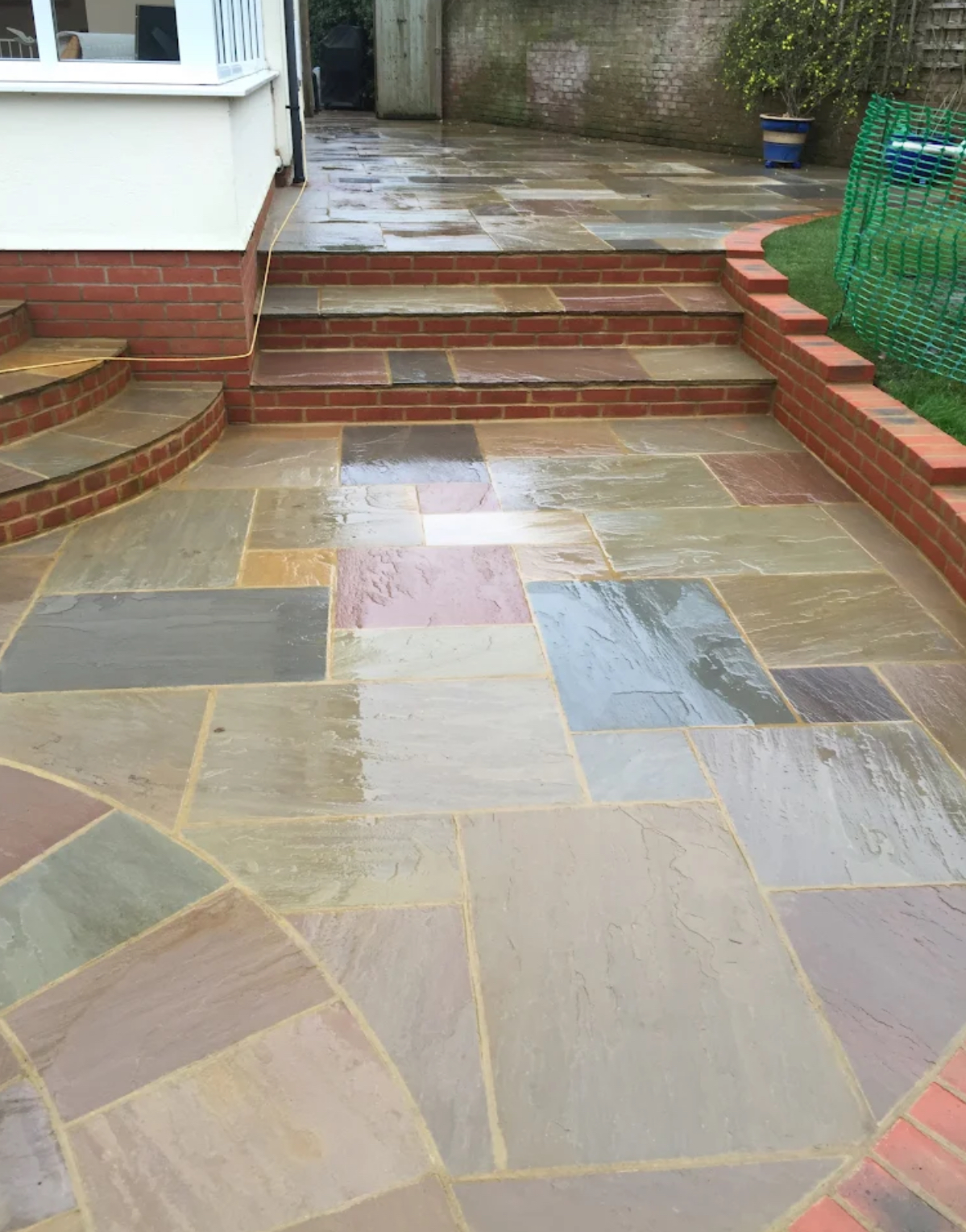
Grey sandstone reads cool and contemporary and silvers slightly with age. Raj Green and Autumn Brown blends carry green, rust and buff together and suit traditional houses. Modak and Rippon buff bring a pink-cream warmth that flatters red brick. Kandla grey and black limestone give the sharpest modern contrast.
All natural stone changes over the first two or three years. Colours mellow, iron in the stone can bloom faintly, and lichen appears on shaded edges. That weathering is the point — if you want a surface that stays exactly as delivered, porcelain is the better choice.
Patterns and layout
Mixed-size packs allow a random pattern with no repeating grid, which is the traditional look and works best on larger terraces. Single-size slabs in coursed or stack bond feel more formal and modern.
We set out every patio from the house line and the main sightline from your rear doors, so full slabs land where they are seen and cuts fall at the edges. Circle features, borders in a contrasting stone and sett-course edges are all options we detail on the survey.
Preparation, bedding and falls
Sandstone is laid on a full wet mortar bed over 100–150mm of compacted MOT Type 1. Because natural stone varies in thickness by several millimetres, each slab is individually bedded and tapped down to the level rather than laid to a fixed screed.
Falls of about 1:80 run away from the house, and the finished surface stays at least 150mm below the damp proof course. Where an existing terrace sits too high against the wall, we lower it or fit a threshold drain — bridging the DPC is how damp problems start.
We prime the back of dense stone where needed and never spot-bed. Hollow bedding is the reason so many patios have that one slab that rocks and cracks in year three.
Jointing, sealing and drainage
Joints are typically 10–15mm on riven stone and pointed with a proper jointing mortar or a slurry-applied compound. Both do the same job: a fully filled, well-compacted joint that keeps water out of the bed.
Sealing is optional and genuinely useful on lighter, more porous stones such as Modak, where it slows staining from barbecues and planters. On grey sandstone we often advise letting the stone weather naturally. A sealer needs reapplying every three to five years, so it is a commitment rather than a one-off.
Where a terrace sits against a lawn or slopes towards the house, we build in a slot drain or channel and take the water to a soakaway.
Maintenance
Brush regularly, wash with warm soapy water, and treat algae in spring with a dedicated patio cleaner rather than bleach. Keep pressure washers on a wide fan at moderate pressure — high pressure erodes the soft riven face and blasts out pointing.
Repointing a section every decade or so is normal on any natural stone terrace, and much easier than people expect.
Recent work
Sandstone Patios projects across Ascot & Berkshire
Work completed across Ascot, South Ascot, Sunninghill, Sunningdale, Cheapside, Winkfield, Windsor, Bracknell, Virginia Water, Bagshot, Camberley and the surrounding Berkshire villages.
“Contacted the team at Ascot Paving Specialists, they were very professional and knowledgeable. Organised a visit, and knew instantly I could trust these people. Work was completed to a very high standard and a few months down the line we have experienced zero issues with their work. Very tidy and friendly, highly recommend!”
Will G
Ascot, Berkshire · Driveway installation · Google review
Read our Google reviews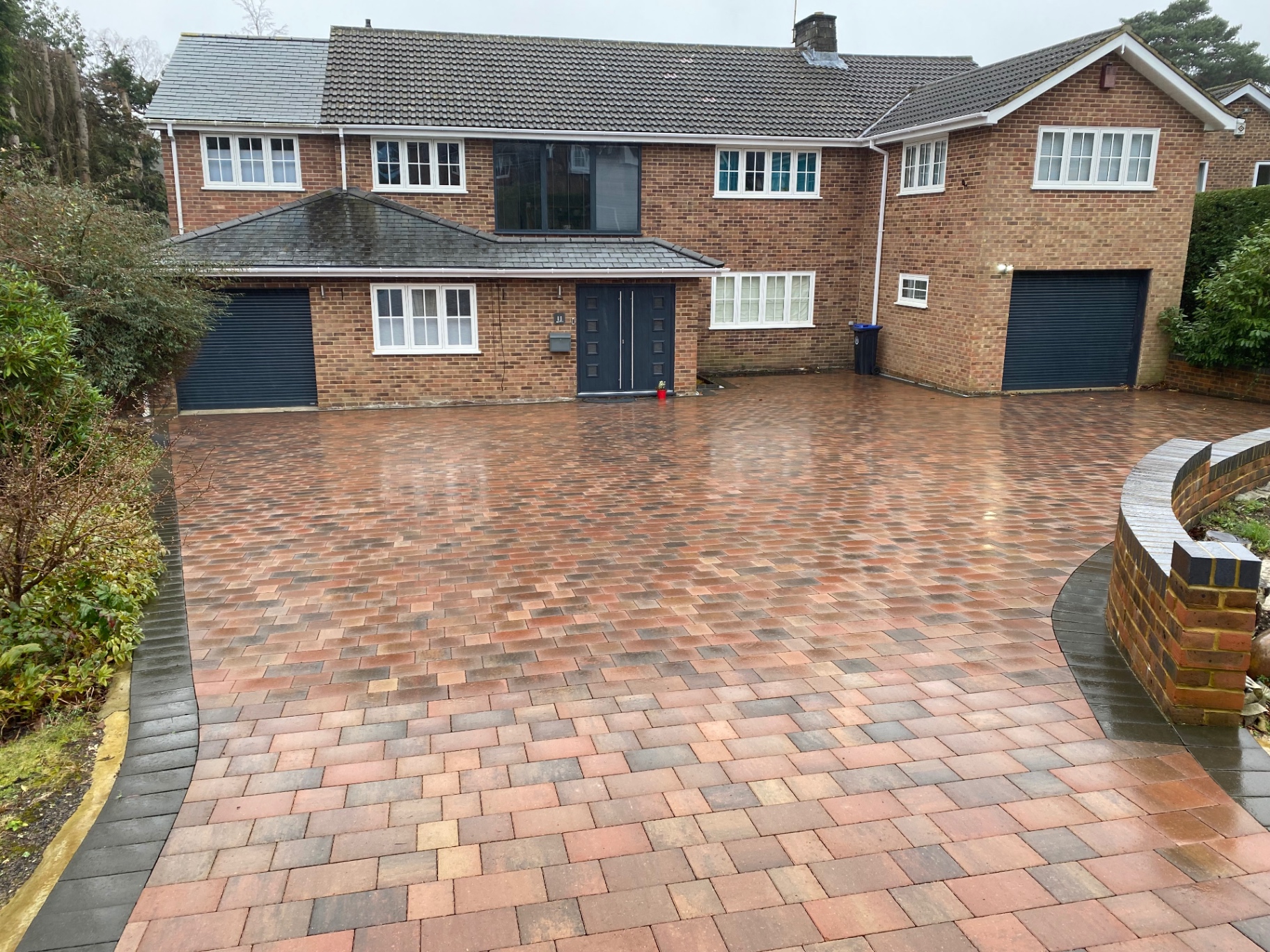
Areas we cover
Sandstone Patios across Ascot & Berkshire
Ascot
Our home patch — from Ascot High Street to South Ascot and Cheapside.
Working in AscotSunninghill & Sunningdale
Established gardens, long approach drives and natural stone terraces.
Working in Sunninghill & SunningdaleWindsor
Period frontages where paving needs to sit sympathetically against brick.
Working in WindsorBracknell
Modern estates, resin bound driveways and low-maintenance gardens.
Working in BracknellVirginia Water
Larger plots, sweeping drives and level changes into the garden.
Working in Virginia WaterFAQ
Sandstone Patios — your questions answered
Related services
Free design & quote
Talk to us about your sandstone patios project.
We visit, measure, check drainage and levels, and send a written quote with the build-up specified. No pressure and no obligation.